
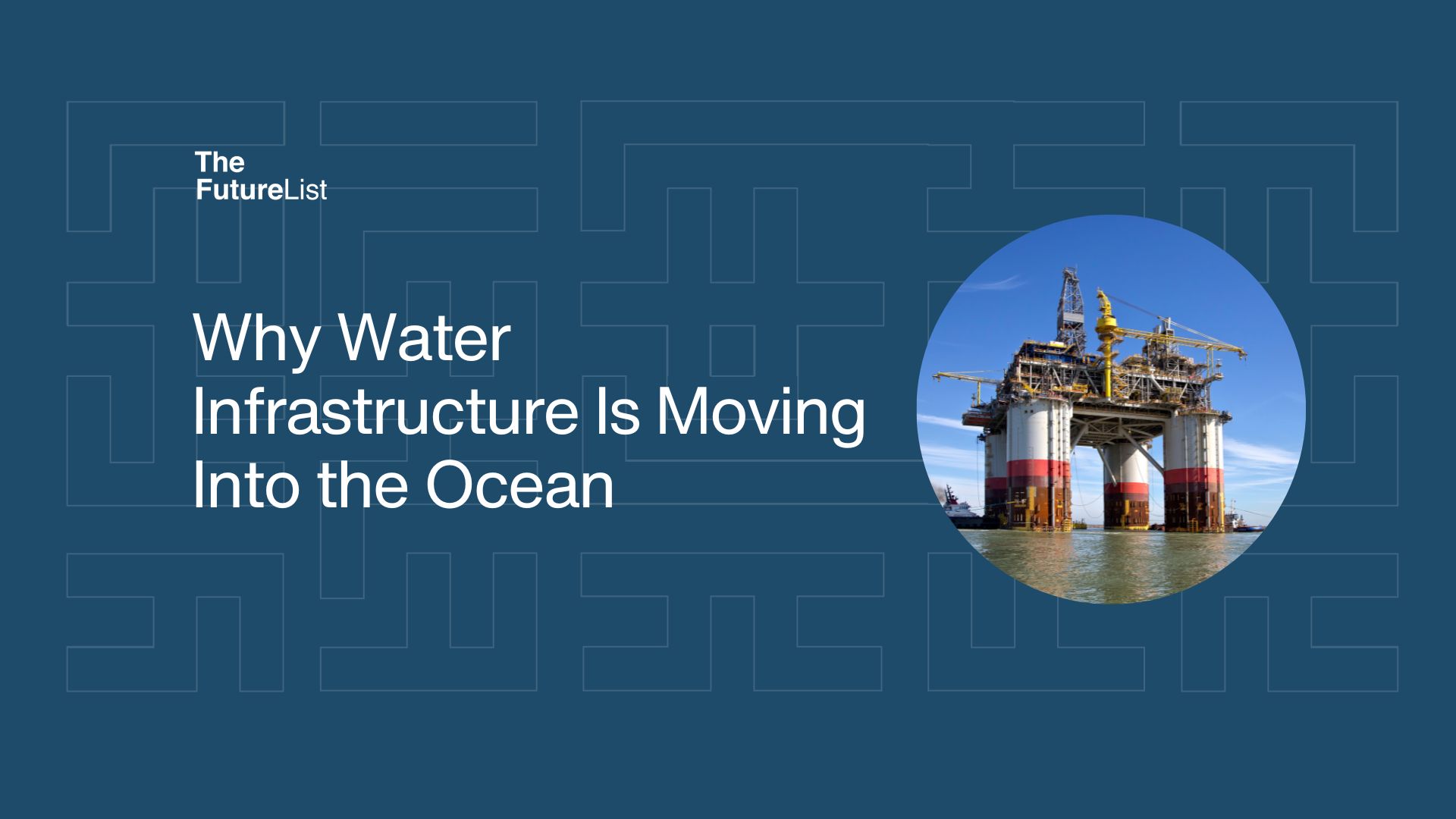
Why Water Infrastructure Is Moving Into the Ocean
Freshwater scarcity is pushing water systems beyond their traditional limits. Inland reservoirs, pipelines, and treatment plants are increasingly constrained by land availability, energy costs, and climate volatility.
A new direction is emerging: water infrastructure is shifting toward the ocean, not just as a source, but as an operating environment. Instead of building larger inland desalination plants, companies are exploring offshore, modular, and digitally managed systems that rethink where and how freshwater is produced.
Offshore desalination is becoming a design shift, not just a technology upgrade.
Startups are beginning to reimagine desalination as a distributed, ocean-based system rather than a centralized facility. Flocean is developing subsea desalination systems that operate underwater, reducing land use while exploring how ocean pressure and modular design can reshape production models.
The key shift is structural: desalination is moving from large coastal plants to smaller, distributed offshore units that can be deployed closer to demand centers.
The Ocean is being reinterpreted as layered infrastructure.
Companies like OceanWell are exploring deep ocean water as a distinct resource layer leveraging its stability and purity compared to surface seawater. This reframes the ocean as more than a single input source. Instead, it becomes a stratified system with different extraction and treatment possibilities depending on depth.
That shift introduces a new infrastructure question:
how do you design water systems around ocean layers, not fixed land assets?
Water systems are becoming software-optimized energy systems.
The biggest constraint in desalination has always been energy. That is now pushing water infrastructure closer to energy optimization and AI-driven control. Gradiant is one example of companies applying advanced process intelligence to industrial water and desalination systems, reducing energy use and improving operational efficiency through digital optimization.
Water treatment is increasingly shifting from static plants to continuously optimized systems that respond to demand, energy availability, and operating conditions in real time.
What this Shift is really signaling?
The most important implication is not that desalination is improving. It is that the geography of infrastructure is being redesigned. Water systems are beginning to detach from land constraints and move into: offshore environments, modular deployment models, energy-integrated systems and AI-optimized operations.
This creates a new infrastructure category that sits between:
Marine engineering, Climate adaptation systems, Distributed energy networks and AI-driven operational platforms
And as that category matures, the question is no longer just how we produce water more efficiently. It becomes:
Where does water infrastructure actually live in a climate-constrained world?
The early answer, increasingly, is: closer to and sometimes inside the ocean itself.
Get innovation insights from The FutureList weekly. Subscribe to our newsletter here