
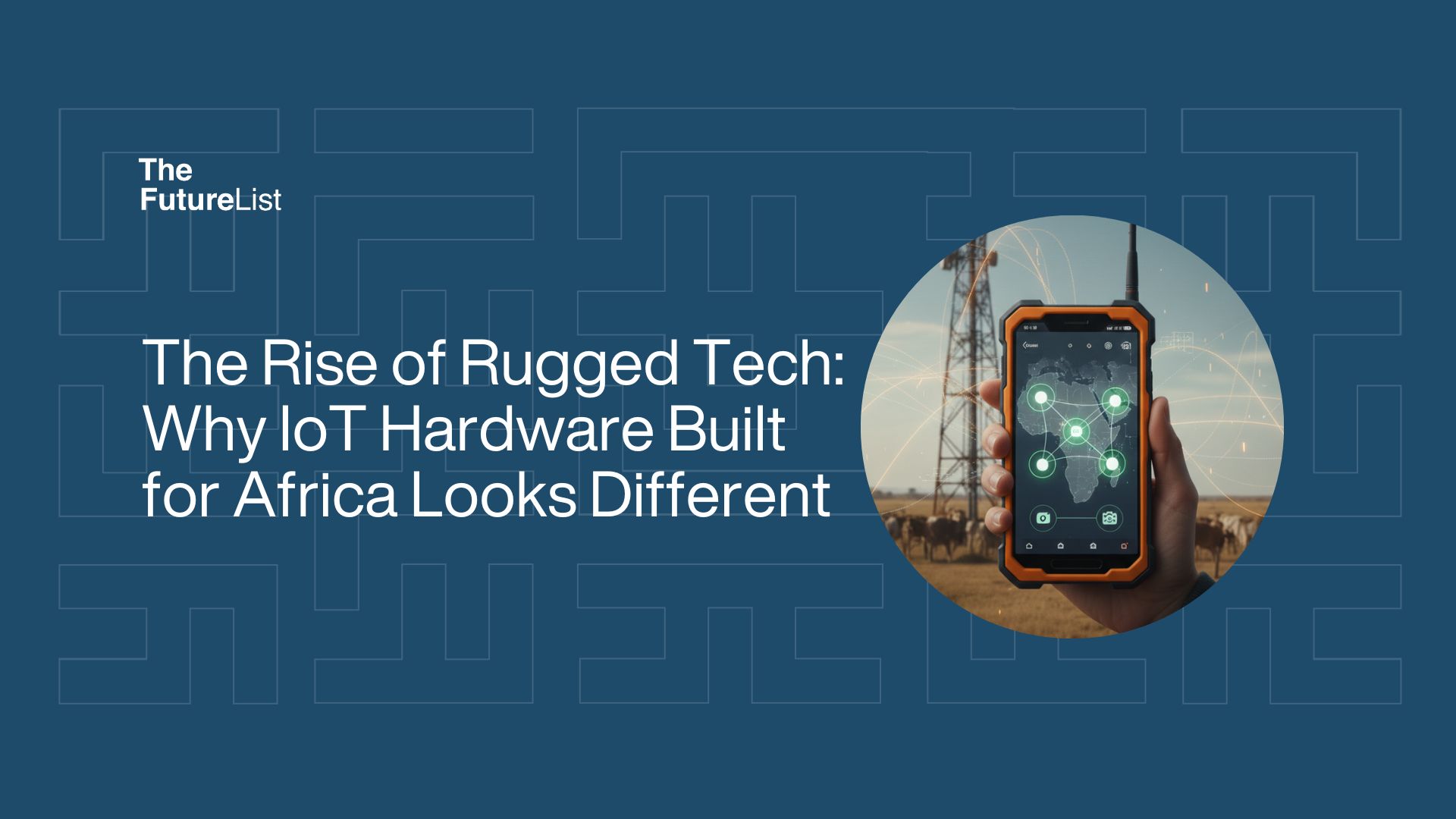
The Rise of Rugged Tech: Why IoT Hardware Built for Africa Looks Different
By David Armaah
Across Africa, the Internet of Things (IoT) is steadily expanding with cellular IoT connections in Africa projected to reach about 35.6 million by 2030. This creates a platform for connected devices across industries from agriculture to utilities. Yet unlike more developed regions, the continent’s hardware ecosystem is shaped by unique infrastructure conditions: intermittent power, dust-laden environments, limited fixed broadband, and diverse climatic realities. These constraints have given rise to an emerging cohort of rugged IoT hardware innovators; African tech builders creating devices tailored for real-world resilience and contextual reliability.
Why rugged IoT matters in Africa
IoT hardware in Africa must function where imported off-the-shelf solutions often fail — when heat, humidity, unstable grids, or weak networks are the norm rather than the exception. This has pushed local innovators to design devices and systems with:
- Durable enclosures and components for harsh weather
- Low-power operation to cope with unreliable electricity
- Offline storage and edge processing to reduce connectivity dependence
- Integration with analytics and cloud services once connections are available
Startups redefining rugged IoT hardware
Geviton (Kenya)
One of the best examples is Geviton, a Nairobi-based IoT and energy hardware startup designing context-aware, rugged devices for emerging markets. Their suite includes:
- smart metering and energy management systems
- air quality and environmental monitors
- telematics trackers
- industrial human-machine interfaces
What sets Geviton apart is its deliberate engineering for challenging operational environments, combining locally designed hardware, firmware, connectivity layers, and cloud analytics – making the devices more reliable and affordable than many imported alternatives. The company reports over 3,000 active IoT devices deployed in real operational settings, with multiple enterprise clients across energy, mobility, environment, and healthcare sectors, validating this market’s appetite for robust hardware built with context in mind.
Sensor Networks (South Africa)
In South Africa, Sensor Networks is another hardware-centric innovator building IoT solutions with real-world durability in mind. Though often positioned within risk and insurance tech, its hardware + networked sensors operate across outdoor environments linked to enterprise clients, adding enterprise-grade connectivity and analytic insight on top of rugged hardware deployments.
MyBitSecure (South Africa)
In the agricultural domain, MyBitSecure is deploying IoT-enabled irrigation and soil-monitoring sensors that can be retrofitted into existing farming infrastructure. Its integrated hardware and software solution not only gathers environmental data but embeds enterprise-grade cybersecurity; a growing necessity when connected devices become part of critical farm operations
Market context: Africa’s growing IoT opportunity
While Africa’s IoT ecosystem still lags behind global averages, its growth trajectory is clear. The Africa IoT market was valued at an estimated USD ~7 billion in 2024 and is projected to expand to more than USD ~20 billion by 2031, driven by sectors such as agriculture, healthcare, smart cities, and logistics.
This expansion is part of a broader digital transformation trend across the continent. Digital transformation markets in Africa are expected to grow at double-digit CAGRs over the coming five years, laying fertile ground for technologies that bridge the physical and digital divide
Looking forward
The future of IoT in Africa will be shaped as much by connectivity improvements including broader 5G availability, as by the ingenuity of local hardware engineers who understand the environments they are building for. Partnerships between innovators, governments, and operators will be critical to scale these solutions across borders, sectors, and use cases.
What makes rugged IoT for Africa exceptional is not just the technology, it’s the contextual mindset: designing with Africa’s realities in mind, rather than importing foreign assumptions. And that mindset is yielding products that are both resilient and ready for the next wave of digital transformation
Get innovation insights from The FutureList weekly. Subscribe to our newsletter here
Categories
- Agritech
- Artificial Intelligence
- Biotech
- Blockchain
- Climate Tech
- Data Infrastructure
- Edtech
- Events
- Fashion
- Fintech
- Healthtech
- Infrastructure
- Innovation Memos
- Innovation Scout Program
- Insight
- Insurtech
- Machine Learning
- Martech
- Mobility
- Music and Media
- Partner Offers
- Perks
- Procurement
- Proptech
- Retailtech
- Ridehailing
- Ridesharing
- Robotics
- Space Aviation
- Supply Chain
- Talent
- Telecoms
- Uncategorized
- Venture Capital
- Wastetech
- Women In Tech
Recent Posts
- Data Sovereignty: Building Trust in Africa’s Digital Governments
- How Computer Vision Is Reshaping Non-Invasive Screening
- The Rise of Rugged Tech: Why IoT Hardware Built for Africa Looks Different
- How Software Is Re‑Wiring the First Minutes of an Emergency
- Crafting Customised Virtual Networks for the 5G Era and Beyond with Network Slicing