
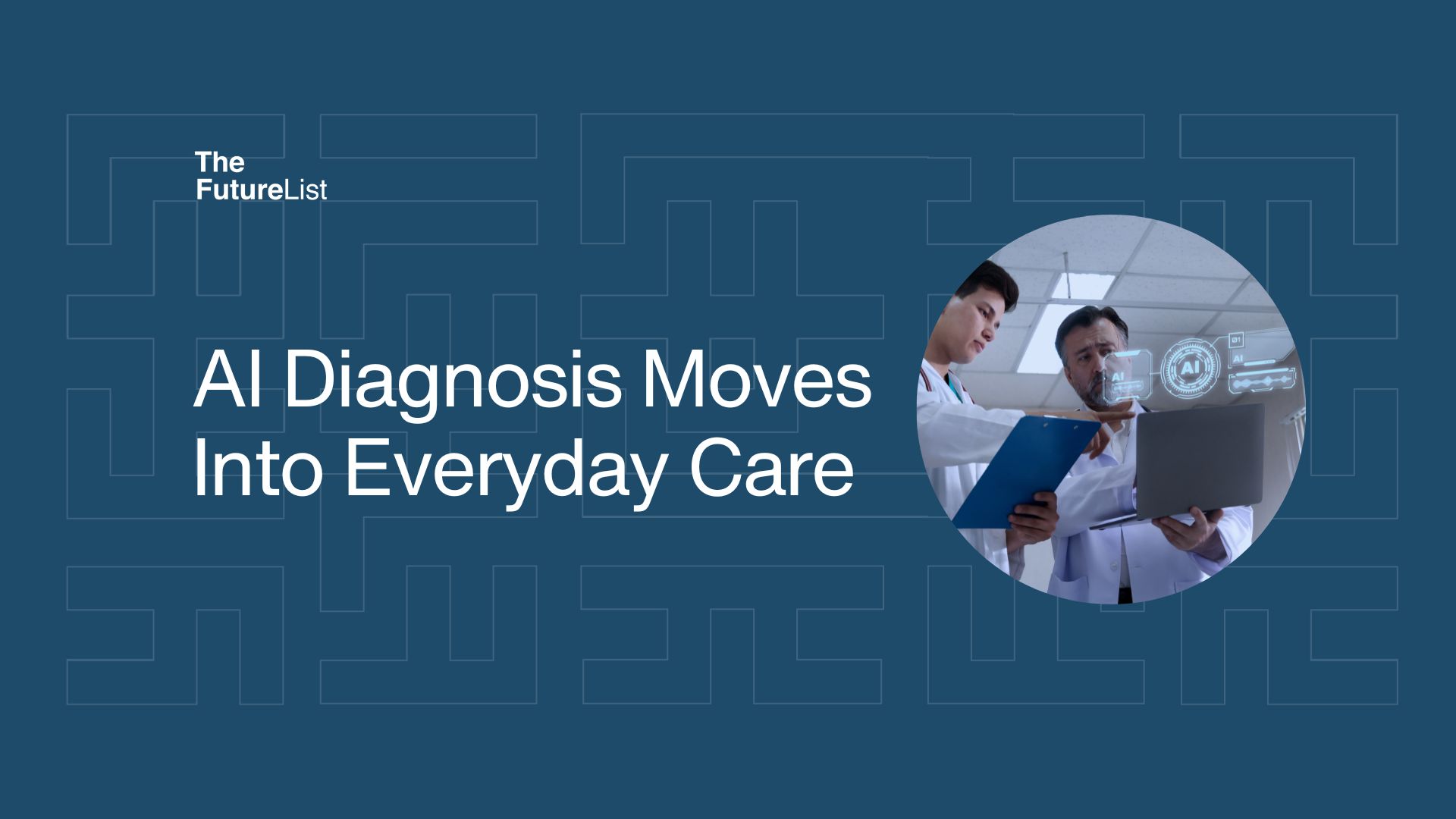
AI Diagnosis Moves Into Everyday Care
By Henry Duah
For years, AI diagnostics lived mostly in research papers and demonstration projects. In 2026, these innovations are increasingly being adopted by health facilities, such as clinics. In Kenya, an AI tool now delivers a malaria diagnosis in roughly 90 seconds with 98.5% accuracy, surpassing the accuracy of most non-specialist laboratory technicians. That single statistic captures the shift underway: the question is no longer whether algorithms can match human diagnostic performance in narrow tasks, but whether they can reach the patients and health workers who need them most.
Furthermore, capital and credibility are converging in the field. The Gates Foundation and OpenAI have committed roughly $50 million in funding, technology and technical support to bring AI tools to 1,000 primary healthcare clinics and their surrounding communities by 2028. The broader market reflects the same momentum: AI diagnostics was valued at about $7.03 billion in 2025 and is forecast to exceed $209 billion by 2034, a compound annual growth rate above 46%. Numbers like these signal that AI diagnosis is moving from philanthropic pilot to commercial infrastructure in the next couple of years.
Why the Frontline is the Real Test
The most valuable tools in a resource-constrained clinic are rarely the most technically dazzling. They are the ones that help an overstretched frontline worker answer simple, urgent questions: Which patient needs attention first? What can we treat here, and who must be referred? A 90-second malaria result matters because it closes the gap between testing and treatment in exactly the settings where a follow-up visit may never occur. Governments are building the scaffolding to support this. Morocco is targeting the full digitisation of patient records by 2030 and smart-technology upgrades to 70 hospitals by 2027, while the Africa CDC’s Continental Health Data Governance Framework was advanced for endorsement at the African Union Summit in February 2026, a recognition that AI diagnosis is only as trustworthy as the data and governance that underpin it.
Great Results, Stubborn Scale
For all the progress, most projects still stall between pilot and national rollout. Africa produces just 2.8% of global AI-health research output, though its impact per paper runs high thanks to strong international collaboration. Uneven infrastructure, fragmented data systems, and thin funding make it hard to turn a successful district trial into a durable national program. The result is a landscape rich in proofs of concept but poor in the unglamorous connective tissue, power, connectivity, maintenance, training and reimbursement that lets a tool survive past its grant.
What Comes Next
The frontier of AI diagnosis is no longer accuracy in a lab; it is reliability in a rural clinic. The winners of the next few years will likely be the tools that assume intermittent connectivity, integrate with the workflows health workers already use, and are governed by data frameworks that patients and regulators can trust. If that connective work gets done, AI diagnosis could function as an early-warning system for whole health systems: catching disease sooner, triaging scarce specialist time, and extending expert-level judgement to places that have never had it. 2026 will be remembered as another year of remarkable pilots that never quite reached the patient.
Sources
- Researchers in Africa Using AI to Fill the Global Health Care Gap (NewsGram) https://www.newsgram.com/africa/2026/02/07/researchers-africa-using-ai-fill-global-health-care-gap
- A big announcement on AI in Africa (Gates Notes) https://www.gatesnotes.com/expanding-access-to-health-care-through-ai
- AI for public health in Africa: beyond pilots (The Lancet Regional Health – Africa) https://www.thelancet.com/journals/lanafr/article/PIIS3050-5011(26)00016-7/fulltext
- GITEX Future Health Africa 2026: AI Moves Toward Real-World Use (Morocco World News) https://www.moroccoworldnews.com/2026/04/289104/gitex-future-health-africa-2026-ai-in-healthcare-moves-toward-real-world-use/
- Digital health innovations in Africa (NIH/PMC Editorial) https://www.ncbi.nlm.nih.gov/pmc/articles/PMC12929092/
Get innovation insights from The FutureList weekly. Subscribe to our newsletter here