
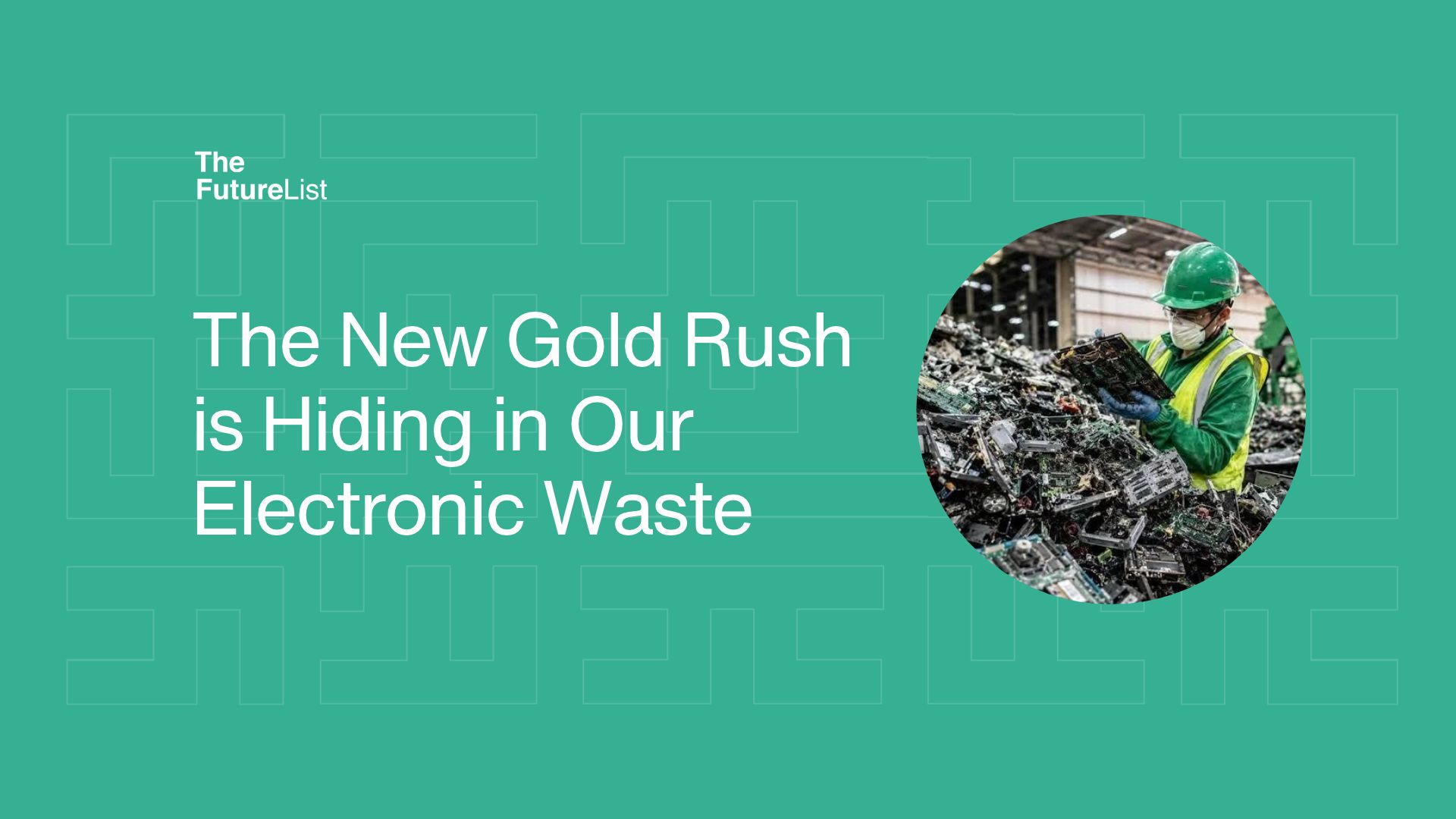
The New Gold Rush is Hiding in Our Electronic Waste
Every year, millions of electronic devices are discarded as newer models enter the market. Old smartphones, laptops, batteries, televisions and industrial equipment often end up in landfills, informal recycling operations or storage facilities. But what if some of the most valuable resources needed to build the next generation of technology are already sitting inside the devices we throw away?
Electronic waste, or e-waste, is increasingly being viewed as more than an environmental problem. It is becoming an important potential source of critical raw materials, including copper, gold, lithium and rare earth elements. And as demand for these materials grows across electric vehicles, renewable energy, robotics and electronics, a new generation of startups is exploring how to recover them.
The growing value of what we throw away
The scale of the problem is considerable. According to the United Nations’ Global E-waste Monitor, the world generated approximately 62 million tonnes of electronic waste in 2022. Yet only 22.3% was documented as formally collected and recycled.
The challenge is not simply finding ways to dispose of old electronics. It is recovering the valuable materials inside them.
Conventional recycling processes are often designed to recover materials available in larger quantities, such as steel, aluminium and copper. However, many of the materials that are strategically important to modern technology exist in much smaller concentrations. Without specialised processing, some of these resources can be lost during recycling.
This is where a new wave of innovation is emerging.
Turning discarded technology into a resource
Startups are developing new methods to recover materials that traditional recycling processes struggle to capture.
One example is Cyclic Materials, which focuses on recovering rare earth elements from discarded products containing permanent magnets. These magnets are used in electric motors, wind turbines, electronics and other technologies.
In September 2026, the company opened a commercial-scale facility in Mesa, Arizona, designed to process up to 25,000 metric tonnes of magnet-bearing products annually. Its technology separates magnets from end-of-life products, allowing valuable rare earth materials and other metals to be recovered and returned to manufacturing supply chains.
Another company exploring this opportunity is Intel-E-Waste, which is developing technology to extract and upgrade valuable metals from complex electronic waste streams and end-of-life solar panels.
In October 2026, the startup was selected for the US National Science Foundation’s Tech Metal Transformation Challenge, receiving support to develop and validate a prototype recovery system. Its approach is particularly interesting because it aims to recover materials that conventional bulk-processing systems can dilute or lose.
The wider innovation ecosystem is also developing new approaches. Through the same challenge, startups such as Infinite Elements are exploring bio-enabled recovery of copper, gallium and rare earth materials from mixed electronic waste.
A new kind of mining
The opportunity is increasingly being described as urban mining: recovering valuable resources from products that have already been manufactured and used.
Unlike traditional mining, which depends on discovering and extracting new deposits, urban mining looks at the materials already circulating through the economy. Old electronics, batteries and industrial equipment become potential sources of raw materials.
This could help reduce dependence on newly mined resources, diversify supply chains and make better use of materials that have already entered the manufacturing system.
However, the opportunity is not without challenges. Recovering materials from complex devices requires specialised technology, reliable collection systems and processes that can operate economically at scale. It also requires stronger infrastructure for sorting, transporting and safely processing discarded electronics.
These challenges are particularly important in regions where electronic waste is frequently handled through informal recycling systems, exposing workers and communities to hazardous materials while valuable resources remain unrecovered.
The next generation of resource recovery
As demand for critical minerals continues to grow, the ability to recover materials from existing products could become an increasingly important part of the global technology supply chain.
The opportunity is not just about recycling more electronics. It is about developing better ways to identify, separate and reuse the materials inside them.
The devices we discard today may contain some of the resources needed to build tomorrow’s technologies. And for the startups developing ways to recover those materials, electronic waste could represent something far more valuable than rubbish: a new source of industrial opportunity.
Get innovation insights from The FutureList weekly. Subscribe to our newsletter here