
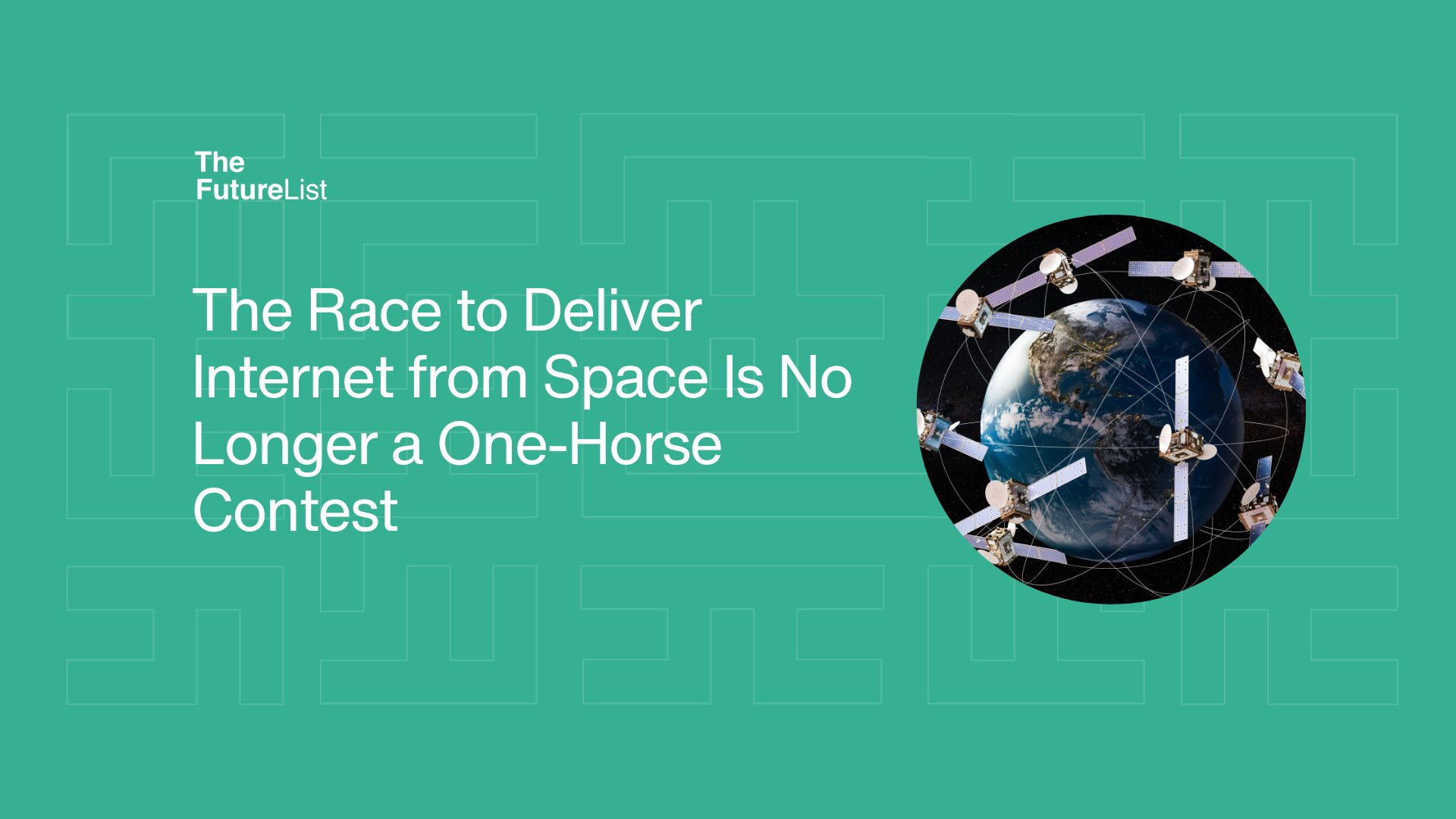
Orbit Shifts: The Race to Deliver Internet from Space Is No Longer a One-Horse Contest
By Eric Kamande
For the past several years, discussing satellite internet connectivity meant, in practice, discussing Starlink. SpaceX’s low earth orbit constellation moved faster and farther than any competitor, accumulating satellites, subscribers, and market presence at a pace that made the rest of the field look almost irrelevant. But 2026 is beginning to look like the year that changes. New constellations are entering service, large telecoms are forging hybrid satellite-terrestrial deals at scale, and a geopolitical dimension is reshaping how governments think about who owns the infrastructure that carries their citizens’ data. For the roughly 2.6 billion people still without reliable internet access, concentrated in sub-Saharan Africa, parts of Asia, and remote regions globally, the stakes are considerable.
Why Low Earth Orbit?
The physics of satellite communication explains much of the current investment. Geostationary satellites, which orbit at roughly 36,000 kilometres above the equator, have served as the backbone of satellite connectivity for decades. But the distance creates unavoidable signal delay of around 600 milliseconds, which makes real-time applications like video calls, online education, and cloud-based services difficult or unusable. Low earth orbit satellites, positioned between roughly 500 and 1,200 kilometres above the surface, reduce that latency dramatically to between 10 and 40 milliseconds, bringing it into a range comparable to many terrestrial broadband services.
The cost of launching satellites has also changed the calculus. The cost per kilogram of putting payload into orbit has fallen from around $85,000 in the 1980s to roughly $1,000 today, according to MTN Group’s analysis of the LEO opportunity. That dramatic reduction, driven largely by reusable rockets, has made the deployment of large constellations economically viable for commercial operators for the first time.
Starlink’s Position and Its Limits
SpaceX entered 2026 with approximately 9,500 working satellites in orbit and FCC authorisation for an additional 7,500, according to industry analyst Quilty Space. Its subscriber base had grown to roughly 9.2 million users across approximately 155 countries. In sub-Saharan Africa alone, Starlink had established a presence in more than 20 countries by the third quarter of 2025, deploying local points of presence in Nairobi and Lagos that brought latency to 53 and 60 milliseconds respectively. By early 2025, its median download speeds in Botswana and Eswatini reached 106 and 86 megabits per second respectively, according to Tech In Africa.
Yet Starlink’s rapid growth has surfaced its own constraints. By early 2026, the service had paused new residential sign-ups in Nairobi, Lagos, and Lusaka due to congestion, an indication that the architecture of LEO systems struggles to scale in dense urban areas. The concentration of infrastructure in a single US-based operator has also prompted concern from governments about dependency. In Kenya, regulators in early 2025 proposed raising satellite landing rights licence fees nearly tenfold, from around $12,000 to $115,000, in part to ensure foreign operators reinvest meaningfully in local economies.
The Competition Arrives
After years of playing catch-up, the rest of the LEO field is becoming consequential. Eutelsat’s OneWeb, operating a 648-satellite constellation, reported 60 percent year-on-year revenue growth in the first half of 2025 and secured approximately 975 million euros in government export credit financing in late 2025, according to Satellite Today. Its parent company has been described as a strategic asset for Europe, partly because it offers governments alternatives to US-controlled infrastructure. In Southern Africa, OneWeb partnered with Paratus Group in November 2025 to expand connectivity for enterprise and mobile applications including mining, logistics, and transportation.
Amazon’s satellite service, rebranded from Project Kuiper to Amazon Leo in November 2025, entered enterprise beta on April 8, 2026, according to The Next Web. CEO Andy Jassy confirmed a mid-2026 commercial launch in his annual shareholder letter. The company has approximately 241 satellites in orbit, well short of the 1,618 the FCC originally required by July 2026, and has applied for a deadline extension to 2028. Amazon lacks its own rocket fleet, relying on ULA, Arianespace, and SpaceX for launches, which constrains deployment cadence. Nevertheless, it has secured enterprise and government revenue commitments and integrates directly with Amazon Web Services, positioning the service as a connectivity layer for cloud and AI workloads. AST SpaceMobile is pursuing a distinct model: large-aperture satellites designed to communicate directly with standard smartphones, removing the specialised terminal requirement entirely. Vodafone signed an agreement with AST SpaceMobile in Europe aimed at eliminating mobile coverage gaps through direct device-to-satellite links.
The Africa Dimension
Sub-Saharan Africa is one of the clearest illustrations of both the promise and the complexity of the LEO moment. Internet penetration across the region stood at 37.5 percent in 2024, compared to over 91 percent in Europe, according to the European Centre for Development Policy Management. Fibre deployment in rural Africa costs approximately $30,000 per mile, according to Tech In Africa, making satellite connectivity not a supplement to terrestrial infrastructure but a potential substitute for it.
Airtel Africa announced a partnership with SpaceX in December 2025 to deploy Starlink’s Direct-to-Cell service across its 14 African markets, targeting coverage for its 174 million customers in areas without terrestrial infrastructure. MTN is simultaneously running trials with Starlink, Eutelsat OneWeb, Lynk Global, and AST SpaceMobile across markets including Rwanda, Nigeria, South Africa, and Ghana. In South Africa, MTN and Lynk Global conducted what was described as Africa’s first satellite voice call using a standard mobile phone in March 2025. Kenya has been in active discussions with Amazon Leo since early 2025 over national broadband deployment. Vodacom has partnered with Amazon Leo to connect rural cell towers across Africa and Europe.
Geopolitics in the Sky and What Comes Next
The constellation race is not purely commercial. Ukraine’s dependency on Starlink for military communications has accelerated the EU’s interest in homegrown alternatives. The IRIS2 project, a 6 billion euro EU initiative, is developing a 170-satellite constellation for secure government connectivity and underserved commercial broadband, framed explicitly around digital sovereignty. China is building its own path through the GuoWang and SpaceSail constellations, with plans for over 13,000 satellites. As Quilty Space has noted, competition in LEO can no longer be assessed purely on the basis of cost per bit. Sovereign connectivity requirements are creating demand that US and Chinese operators cannot always fulfil for political reasons, opening space for European, Gulf, and potentially African alternatives over time.
Hardware costs for consumer terminals remain a barrier, though they continue to fall. Spectrum allocation conflicts between constellations are growing as orbit becomes more crowded, and the ITU framework for managing them is under strain. The governance question is ultimately the most consequential one. A satellite terminal in a rural school connects that school to the world, but the data travels through infrastructure owned and operated elsewhere. Whether the LEO expansion strengthens or complicates digital sovereignty for developing-country governments will depend on regulation, local partnership requirements, and how quickly alternatives to the current dominant players mature.
Get innovation insights from The FutureList weekly. Subscribe to our newsletter here